


Trevosa
Narrative deduction: decode Trevosan through context, trace30 family members across 7 generations. 3-4 hours. Inspired by Rottrees Are Dead. No hints—learn by experimenting.
Category
Puzzle Game
Rating
4.3 / 5
Votes
1692
What to expect
A Trevosa guide for understanding language decoding vs genealogy solving, managing the notes system, using search strategically, and knowing if this3-4 hour deduction puzzle suits you.
What Trevosa Offers
Trevosa is a narrative deduction game where you play Ludir, oloth-til (son) of Oreleth-cyno-taayen, attempting to identify the legitimate heir to Trevosa’s throne. The challenge is twofold: decode the Trevosan language through context clues, and use that understanding to trace seven generations of a royal family across 30 members. Documents are written entirely in Trevosan—no English translations—so you’re learning vocabulary, grammar, and family relationships simultaneously while solving a succession mystery.
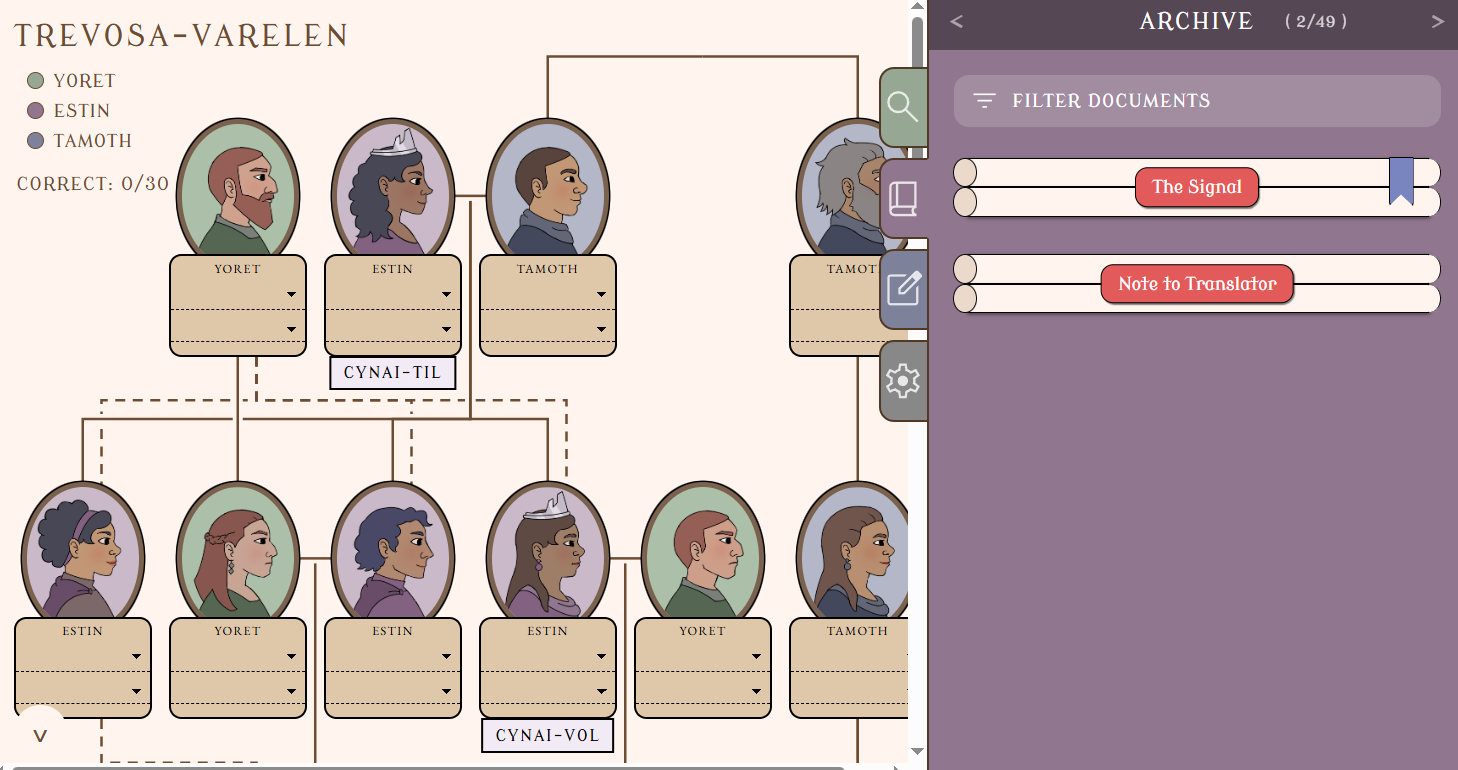
The game presents an archive of chronological documents (oldest to newest) containing royal announcements, marriage records, death notices, and political correspondence. You click highlighted words to search for other documents containing those terms, gradually building your understanding of what each word means and how family members connect. Once you’ve decoded enough language and traced enough relationships, you fill in the family tree with names and titles. When three members lock correctly, you know you’re on the right track.
The browser version runs without download and saves progress locally (except Safari, which blocks embedded storage). Playtime ranges from 1-4 hours depending on whether you read every document for lore or skip straight to solving the puzzle. The game is inspired by The Roottrees Are Dead and shares DNA with Chants of Sennaar and Her Story—if you’ve enjoyed those, Trevosa hits similar notes.
How Language Decoding Works
Trevosan uses gendered and relational word forms that shift based on context. “Oloth-til” means son, “olaith-til” means daughter, “levoth” means brother, “talo” means grandfather. Royal titles include “cyno” (king), “cynai” (queen), andyne” (gender-neutral ruler). The language includes non-binary characters using neutral terms, which adds complexity because you can’t assume gender from title alone.
Learning happens through repetition and pattern matching. Early documents use simpler sentences—announcements of births, wedings, deaths. As you progress chronologically, documents become more complex, referencing earlier events and using vocabulary you’ve already decoded. The game doesn’t provide a dictionary or grammar lessons; you infer meaning from context and test hypotheses by searching related terms.
The notes tab is essential. Most players report that without maintaining a running translation glossary, they get stuck midway when documents reference obscure family members or cultural practices they forgot. The game expects you to build your own reference system, which mirrors real linguistic analysis. If you prefer games that give you tools rather than making you create them, this design choice might feel unnecessarily tedious.
What the Search System Actually Does
Clicking a highlighted word in any document searches the archive for the first three documents containing that term. This creates a navigation puzzle on top of the language puzzle—you need to identify which words lead to useful documents rather than dead ends. The Settings option “show undiscovered counts” helps by displaying how many new documents each word unlocks, but even with that enabled, you’re still choosing search paths strategically.
The chronological archive ordering matters because understanding early events (the founding rulers, initial succession rules) provides context for later drama (exiles, disputes, hidden marriages). Reading documents out of order can leave you confused about why certain family members are excluded from succession. The game rewards methodical players who work through the archive systematically rather than jumping to conclusions based on partial information.
The search-by-clicking design means you’re constantly togling between reading documents for content, clicking words to find related documents, and updating your notes with new vocabulary. This loop is satisfying if you enjoy incremental discovery—each new word reveals more documents, which teach more words, which unlock deeper lore. It’s less engaging if you want direct answers or clear progress markers showing you’re on the right track before the final solution.
How to Play Trevosa
Search Documents
- Click on highlighted Trevosan words or use the Search tab to find documents mentioning specific terms or family members.
- Each search reveals the first three documents containing your search term.
- Documents are archived chronologically from oldest to newest.
Decode the Language
- Learn Trevosan words through context clues in documents.
- Words indicate family relationships (leevoth=brother, talo=grandfather), royal titles (cyno=king, cynai=queen), and cultural terms.
- Use the Notes tab to record your translations this is essential for solving the puzzle.
Build the Family Tree
- Set each person’s name and title in the family tree based on evidence from documents.
- Once you correctly identify 3 people, they lock in place.
- Analyze relationships, succession rules, and events like weddings (varveitabeir) and funerals (varveicynvei) to determine the true heir.
Who This Puzzle Suits
Trevosa works for players who enjoy linguistic puzzles, genealogical deduction, and narrative mysteries that reward patience. If you’ve played The Roottrees Are Dead or Return of the Obra Dinn and found satisfaction in solving backwards from clues, this delivers similar appeal with a language-learning twist. The 3-4 hour completion time assumes thorough engagement—speed runners who ignore lore can finish faster but miss the story.
It’s less suited to players looking for action, time pressure, or clear feedback loops. There are no hints beyond the documents themselves, noundo button if you fill the family tree incorrectly, and no way to verify partial solutions until you lock three members. If you prefer puzzles with incremental validation confirming you’re on the right path, Trevosa’s all-or-nothing structure might feel punishing.
The language system assumes you’re comfortable with pattern recognition and ambiguity tolerance. Early on, you’ll encounter words whose meaning you can only guess at, and you won’t know if you’re right until later documents provide clarifying context. Players who need immediate confirmation of correct answers may find this frustrating. Players who enjoy deduction under uncertainty will find it compelling.
The royal succession mystery provides narrative motivation beyond pure puzzle-solving. You’re not just filling in a family tree—you’re uncovering political intrigue, exile, hidden marriages, and the “dreadful nyscet” threatening Trevosa. The twist at the end recontextualizes the entire puzzle, which rewards players who engaged with the full story rather than treating it as abstract logic.
The browser version’s Safari storage limitation is a genuine constraint. If you’re on Safari and can’t switch browsers, expect to lose progress between sessions unless you manually screenshot your notes. Chrome, Firefox, or Edge provide reliable autosave.
For another browser deduction puzzle with different mechanical focus, try TADC Mind Games, a psychological horror VN with choice-driven deduction.
Share your tips for Trevosa
Share a useful tip, a favourite route, or a correction that can help the next player.
Comments are not collected on this independent fan site.
To report a broken game frame or suggest a guide correction, email [email protected] with the page URL.